

World Labs has introduced Atlas, a single model that generates 3D scenes from photographs, reconstructs real places from a handful of shots and simulates them well enough to produce the sensor data a robot would see moving through them. It is the first model the company has built for spatial intelligence at large scale, the idea it has pursued since it was founded. Atlas is available only to selected partners under an early access program, and will sit underneath the next versions of Marble, the product World Labs already ships.
The technical claim is about representation. Atlas is multimodal and trained from scratch on text, images, video and 3D data, and every input fragment is bound to a position in three-dimensional space rather than handled as part of a flat sequence. World Labs calls that shared representation "spatial context," and says it is what separates Atlas from systems trained only on language or video. Fei-Fei Li made the same argument in an essay: current multimodal language models and video diffusion models break data into one- and two-dimensional sequences, which makes even simple spatial tasks unreasonably hard, and what is needed are architectures whose tokenization, context and memory account for three- and four-dimensional space.
In camera-controlled generation, Atlas takes one or more images and produces new views from positions and angles the user chooses. The camera path is specified directly as geometry rather than described in a text prompt, which is how video models usually handle it. The model generates up to one minute of video at 1440p, with the user controlling every frame and every viewpoint instead of accepting whatever comes back.
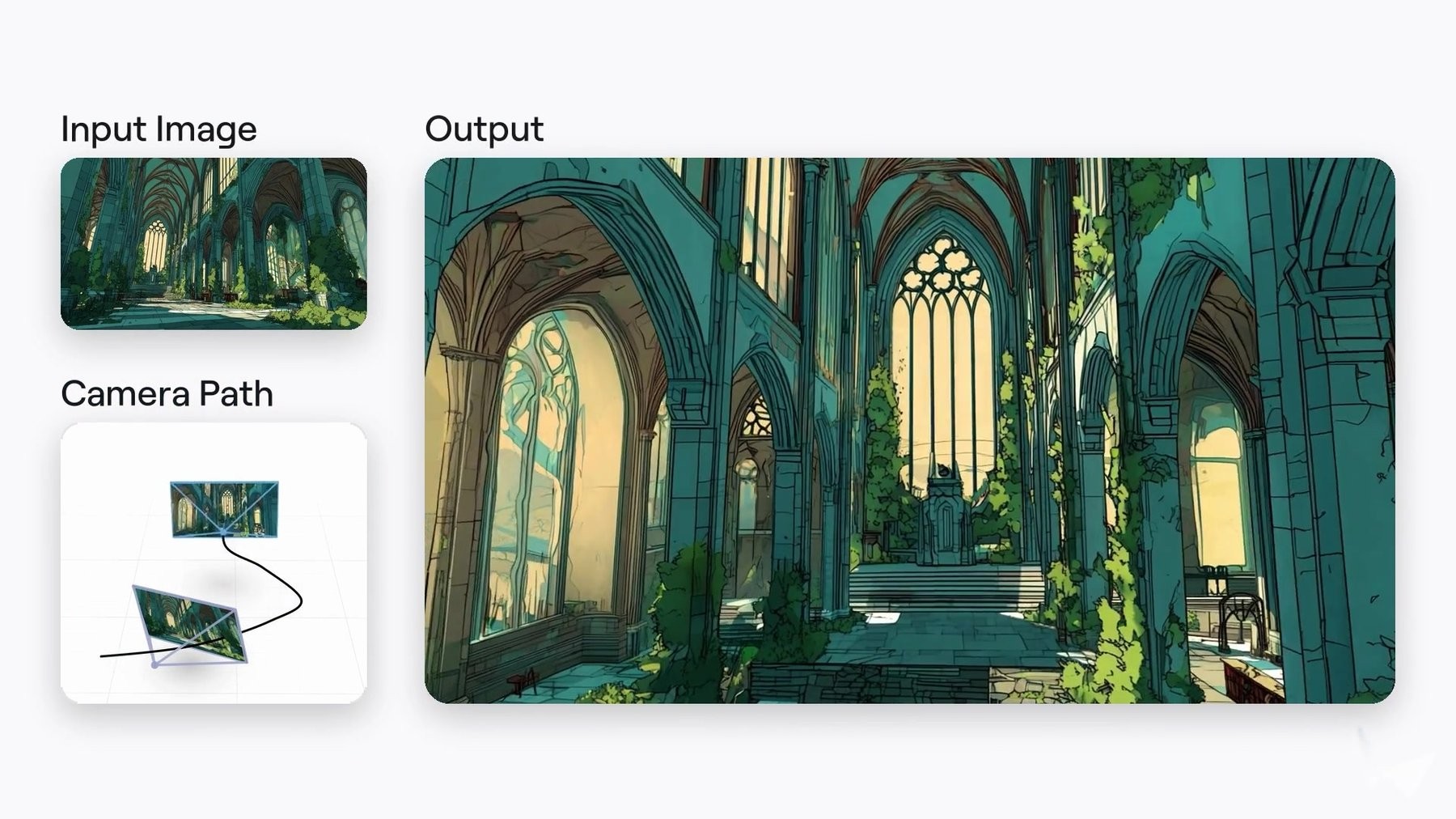
Atlas takes a source image and a specified camera trajectory as geometric input and generates the corresponding new view
Source: the-decoder.com
For reconstruction, Atlas rebuilds real scenes from anywhere between one photograph and a few dozen, with no special capture equipment. The more images it gets, the less it has to fill in from its own priors. World Labs says two or three photographs are already enough for an accurate result that beats specialized 3D models, and that Atlas can take more than 100 input images. In one demonstration it assembled Stanford's Main Quad from ground-level photographs, working up from two shots to 25, then generated views of the campus from the air.
Large camera movement is exactly where existing systems fall apart. In a comparison on the OpenWorldLib platform, models such as VGGT and InfiniteVGGT quickly produced geometric inconsistencies and blurred textures. Atlas returns actual 3D data rather than only an image or a video: it handles depth alongside RGB colour, and supports point clouds and 3D Gaussian splats, formats that describe a scene as a mass of small spatial points and can be viewed smoothly from any angle. Marble already uses the same format.
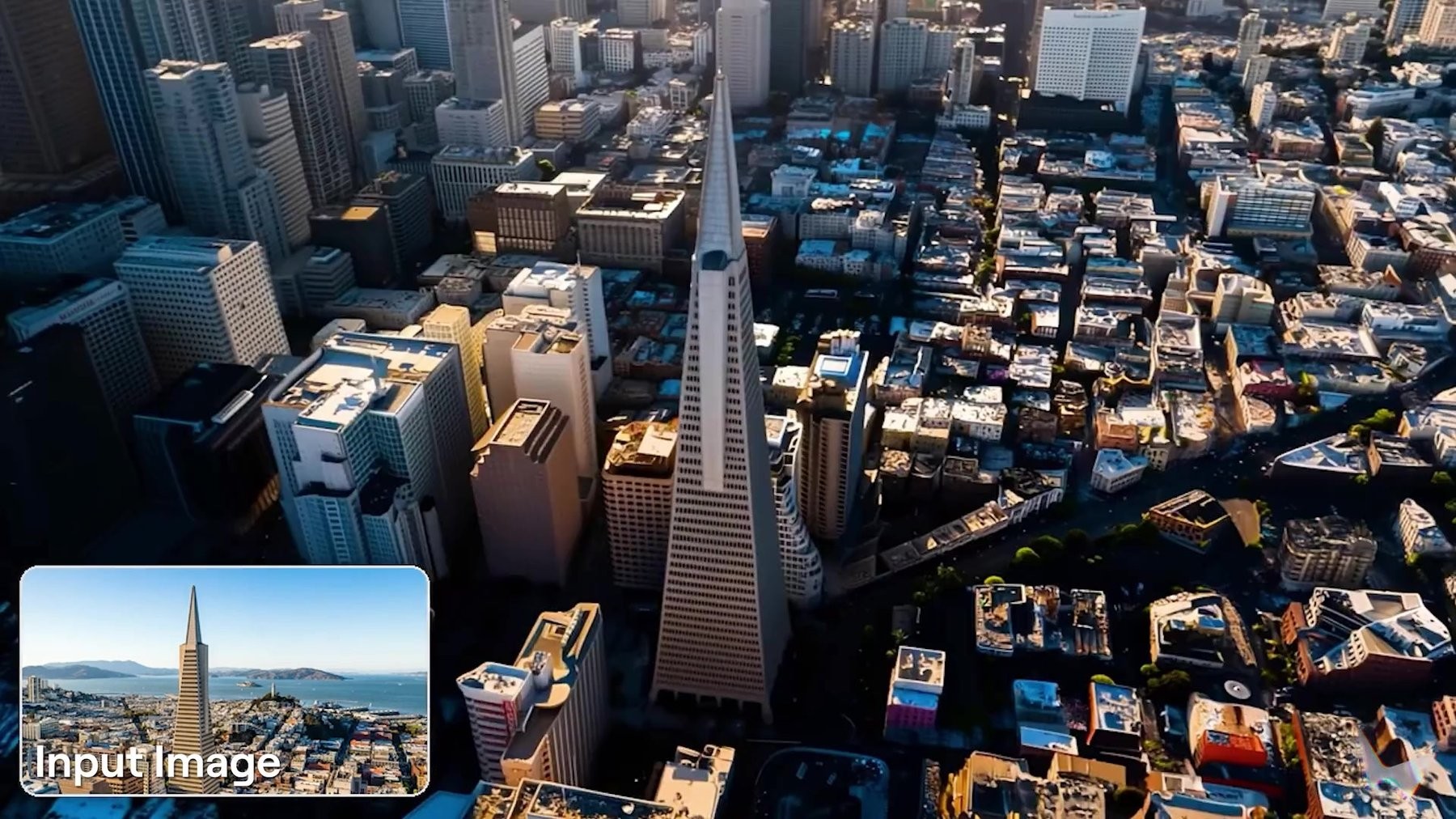
From a single photograph taken at street level, Atlas generates aerial views shot high above the city
Source: the-decoder.com
Source: the-decoder.com
Atlas models space and time together. Given video shot with only a few cameras, it can produce a "zero time" effect, freezing a scene so it can be inspected from angles ordinary filming could not reach. The demonstration used several smartphones and moving cameras rather than professional rigs.
Robotics is where the company is pointing all of this. Atlas serves as the bridge from the real world into simulation: it reconstructs a room and generates the images and depth data a virtual robot's sensors would see along its route. From a few photographs it can spin out variants of a pick-and-place task by changing the objects, their positions, the lighting and the background, which is how World Labs expects to get diverse robot training data without filming every possible situation.
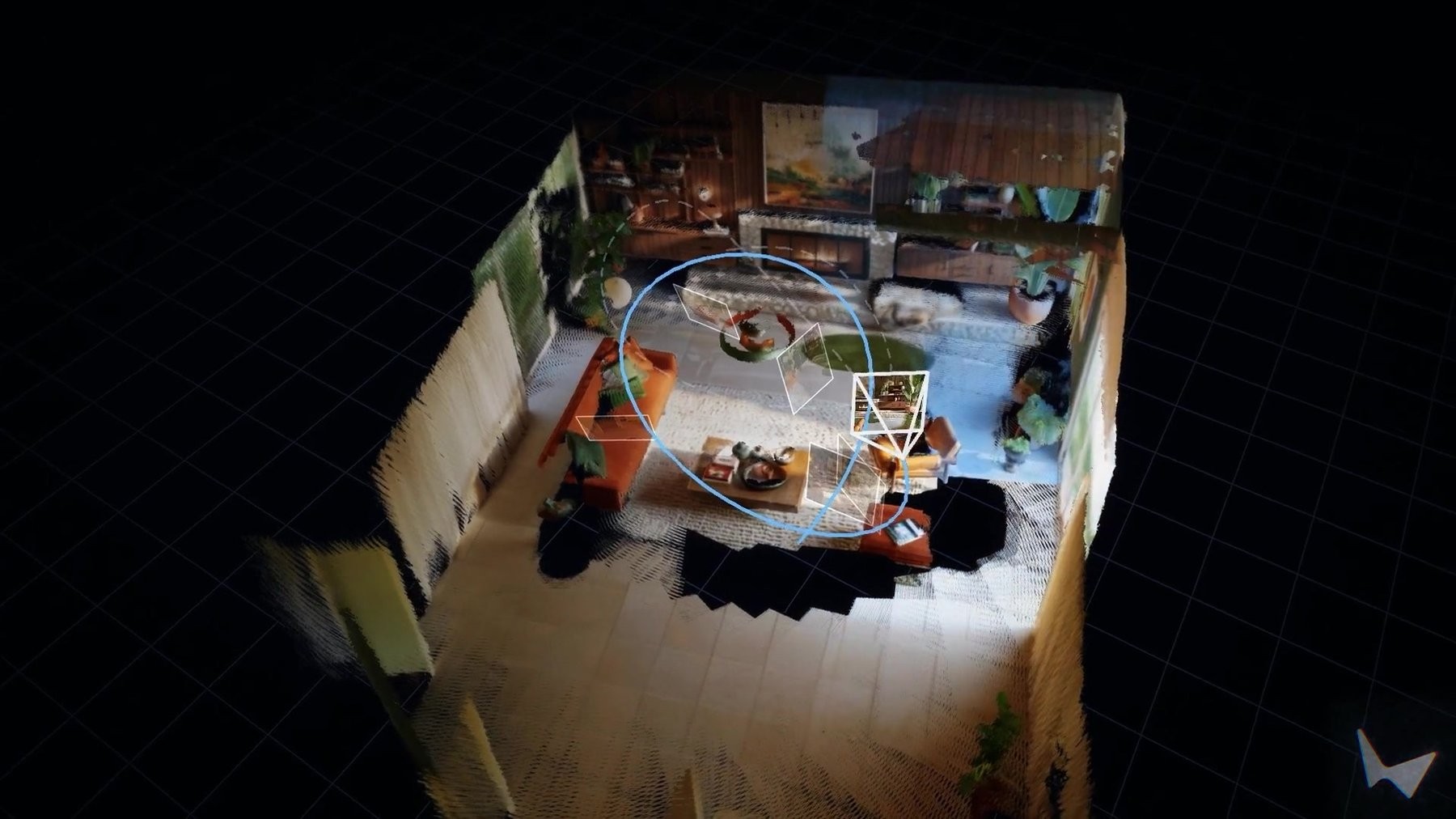
Beyond images, Atlas also outputs scenes as explicit 3D data — here shown as a point cloud with the corresponding camera trajectory
Source: the-decoder.com
World Labs showed this approach last month as a separate product, a real world to simulation to real world engine that builds thousands of variants of a single real task and trains control models entirely in simulation. On five robot platforms, the company says, those models ran for an hour without human intervention. The technology came from SceniX, which World Labs acquired.
Text-to-image is not the point of Atlas, though it will follow complex prompts, render text, produce different visual styles and generate 360-degree panoramas. Architecturally it borrows from both camps: it generates in steps like a language model, which lets it use the same acceleration tricks including KV caching, and it applies diffusion, gradually denoising the result, which opens up methods that shorten denoising or raise image quality.
Source: the-decoder.com
World Labs says no single metric captures what Atlas does and points to two test suites, camera-controlled generation and few-view 3D reconstruction, claiming Atlas leads more specialized models in both. In the camera-controlled tests, external evaluators preferred Atlas 75% of the time against MiniMax H3, 81% against Gemini Omni Flash, 86% against Happy Horse 1.1, 93% in one further comparison where the source does not name the opposing model, and 94% against Seedance 2.5. In reconstruction, Atlas posted a median error of 25.3, ahead of Pi3X and VGGT-Ω 1B.
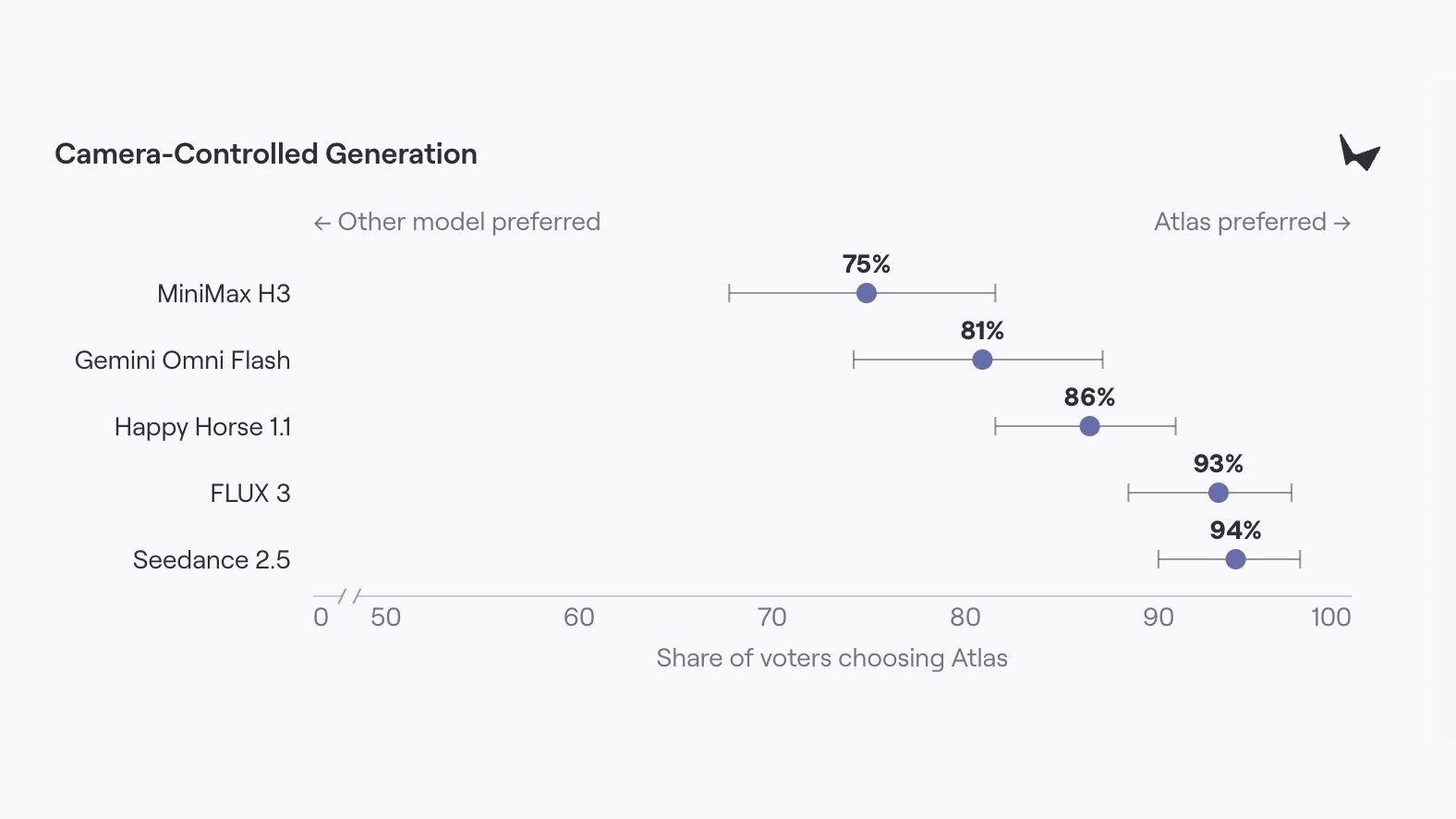
In head-to-head tests of camera-controlled generation, most evaluators consistently chose Atlas
Source: the-decoder.com
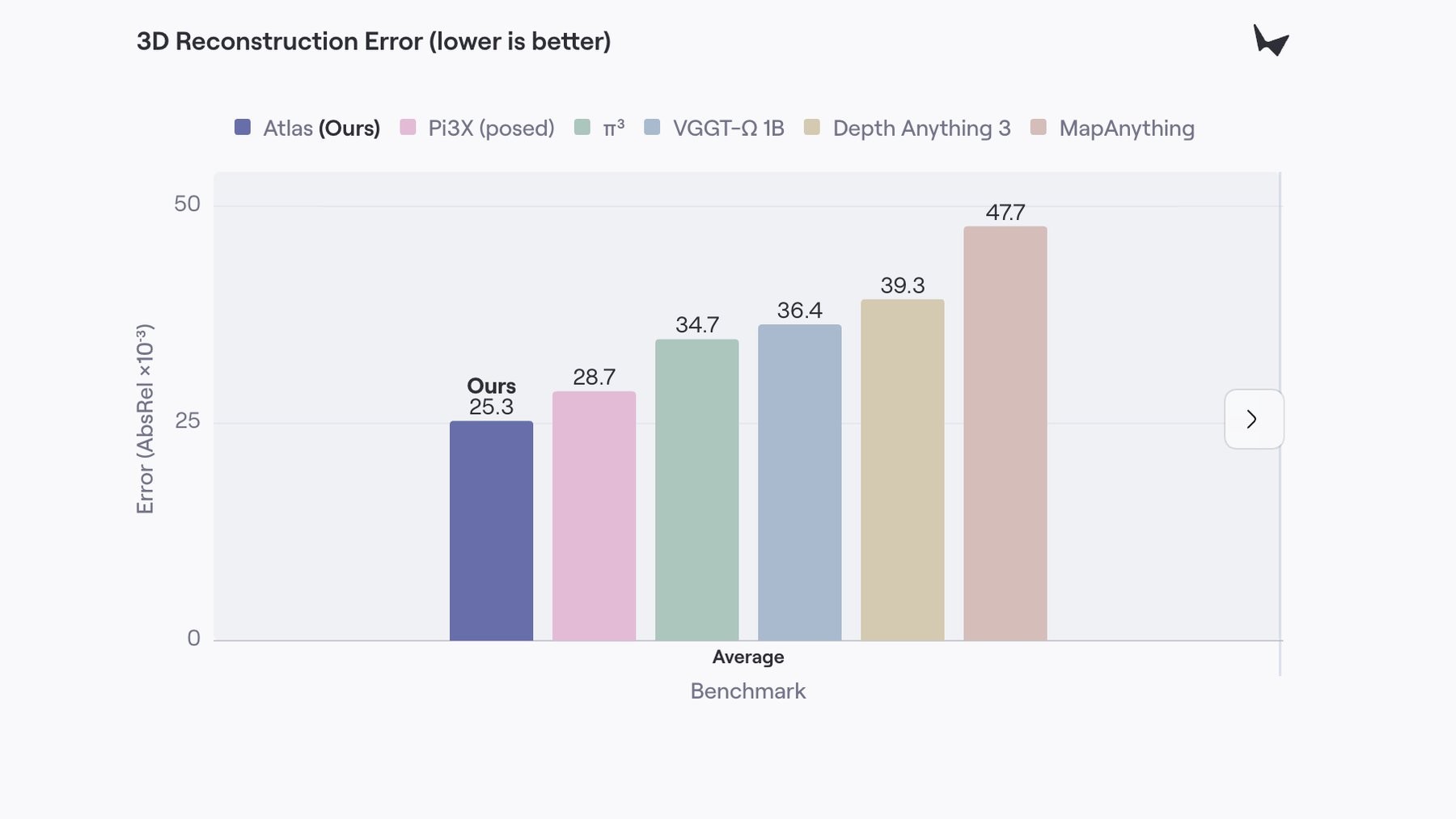
Atlas shows the lowest average reconstruction error of all the specialized models compared; lower is better
Source: the-decoder.com
Those two sets of numbers are not the same kind of evidence, and the weaker one is doing most of the work. The percentages are human preference rates against video generators, and a preference rate measures which clip people liked better, not whether the geometry was right. The one figure that measures geometry is the median error of 25.3, stated without a unit, and 93% is credited to a comparison with no named opponent. The company also says quality rises with training compute and expects that to hold as it scales, without publishing the compute. Notably absent is anything an engineer would use to plan around Atlas: no model size, no throughput or latency, no price, no general availability. The robotics result has the same shape — an hour of uninterrupted operation on five platforms is a duration, not a success rate.
The pressure to publish something impressive is easy to locate. World Labs was founded by Fei-Fei Li, who created ImageNet and ran AI at Google Cloud, and was backed at the start by Andreessen Horowitz, AMD, Intel and Nvidia. Its first system let users move through a generated scene for only a few virtual metres before they hit invisible walls; Marble followed. Then the company raised $1 billion from Autodesk, Andreessen Horowitz, Nvidia and AMD, after Bloomberg reported talks valuing it at $5 billion. Atlas is the first thing it has shown that has to carry a number that size.
The field cannot yet agree what counts as a world model. An international team led by Peking University proposed a common definition through OpenWorldLib: pure text-to-video systems do not qualify, because they have no feedback loop with the real world, while 3D reconstruction and simulators of the kind inside Atlas are basic components of one, since they create environments in which physical rules can be tested.
Source: the-decoder.com
By that standard Atlas is a component rather than the thing itself, and the piece that would close the loop is the robot engine. The evidence for that piece is an hour per platform and a set of demonstrations World Labs chose. Early access partners will be the first to run the camera somewhere nobody picked in advance.