
XDOF is in late-stage talks for a Series B that would value the robotics data startup at $1.2 billion, about three months after it came out of stealth. The company was not looking for the money. People familiar with the deal told TechCrunch that XDOF had no plan to raise again so soon after its $70 million Series A in June, and that venture funds approached it after watching how quickly it grew. Terms can still move, and TechCrunch could not determine how much is being raised or whether the new capital sits inside the $1.2 billion figure. XDOF and 8VC did not respond to requests for comment.
Thrive Capital, Andreessen Horowitz, Lux and Spark Capital took part in the June round. A new round at $1.2 billion would reprice the company several times over in a single quarter, on the strength of a business that reported roughly $50 million in annualized revenue and 20 customers, several of them frontier AI labs.
What XDOF sells is the unglamorous layer underneath robot learning: data pipelines, collection tooling and labeling systems that frontier labs and robotics companies find difficult to build for themselves. The company's ambition is to be the outside data supplier for the robotics industry, in the way that a handful of firms became the outside data suppliers for language models.
That comparison is the one investors keep reaching for. They describe XDOF as Scale AI or Mercor for physical robotics. The logic is straightforward: language models had the entire internet to train on, and robots have no equivalent corpus of real-world behavior. There is no scraped archive of a human hand closing a cardboard box. Collecting that behavior is the bottleneck standing between today's demos and a general-purpose robot, and whoever industrializes the collection captures a toll on everyone else's progress.
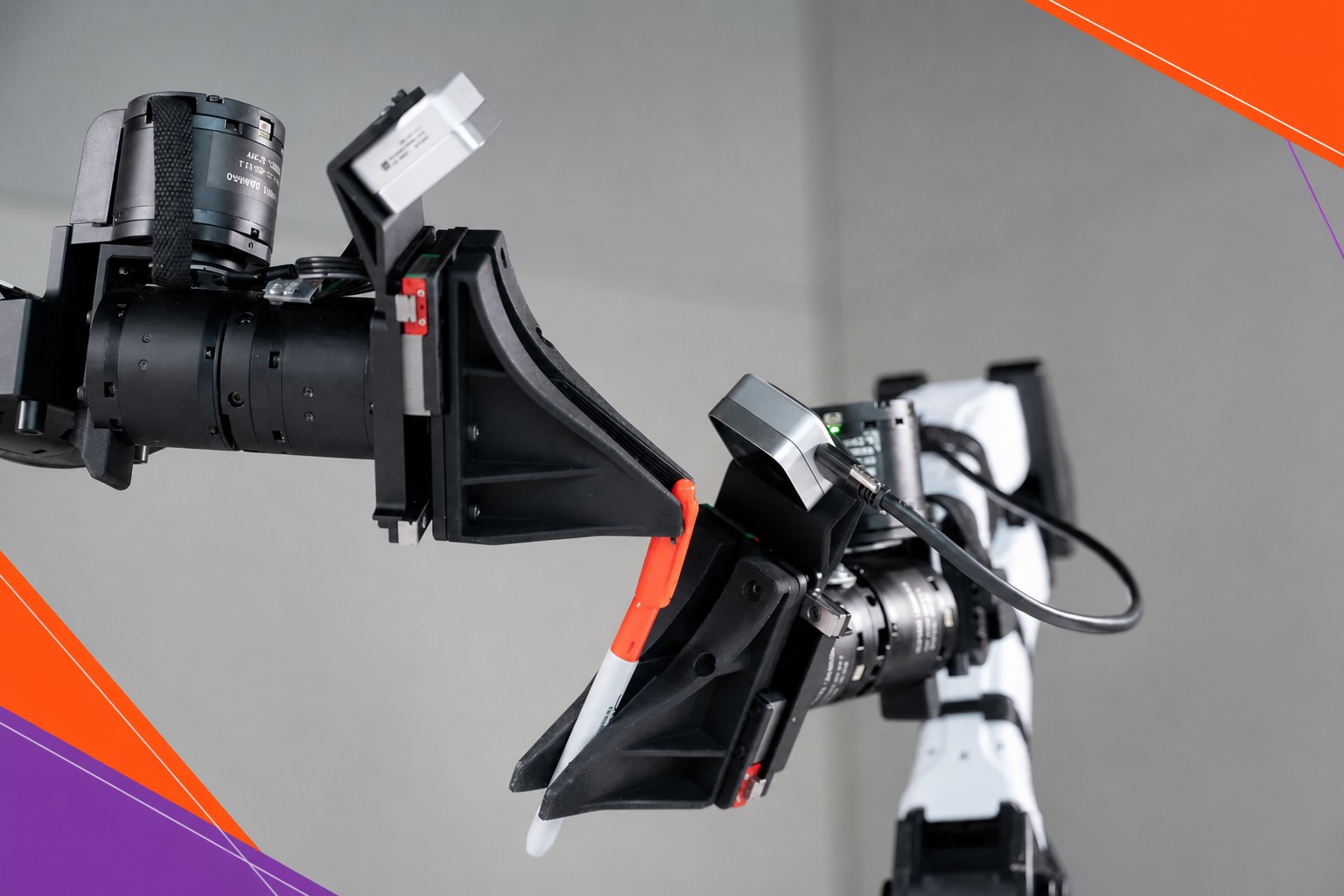
The founders came to the problem from the research side. Philipp Wu began working on robot learning from large datasets during his PhD, and has said the limiting factor in his research was the absence of data at scale. With Fred Shentu he built GELLO, a low-cost teleoperation rig that lets a person drive a robotic arm remotely and generate training data in the process. The work became an influential robotics paper and the foundation of XDOF.
The company is now running that idea at industrial scale. Working with the AI research lab at the University of California, Berkeley, XDOF is assembling what it believes is the largest set of high-quality robot training data ever collected, a project it calls ABC. The method combines two streams: robots driven by remote teleoperators, and people wearing body sensors who simply record ordinary tasks, folding clothes or flattening boxes, from a first-person point of view. XDOF plans to hire and train both kinds of collection teams worldwide.
Put the numbers next to each other and the price starts to look like a statement about the category rather than the company. At $1.2 billion against roughly $50 million in annualized revenue, investors are paying about 24 times revenue for a business whose primary input is people wearing sensors. That is a software multiple on an operation whose costs scale with headcount, geography and hours recorded. The bet only works if the data XDOF accumulates becomes an asset that outlives the contract that paid for it.
Which is the question nobody involved is answering in public. Nothing that has leaked about the round says whether the data XDOF collects for a customer is exclusive to that customer or reusable across the book. Those are two entirely different companies. If every frontier lab commissions its own bespoke corpus, XDOF is a very well-tooled staffing firm with 20 clients and a hiring problem on four continents. If ABC and its successors are proprietary assets XDOF licenses repeatedly, the multiple makes sense and the moat compounds with every hour recorded. The customer list cuts both ways too: the 20 buyers include the labs best positioned to bring collection in-house the moment it becomes their largest line item.
The competition is arriving on both flanks. Mecka AI is also collecting real-world robot training data. Scale AI and Micro1, which built their businesses annotating data for language models, are moving into the same territory with existing operational scale and existing relationships with the same labs.
The round prices a conviction that the data shortage blocking general-purpose robots will last long enough to be worth $1.2 billion. XDOF's proposed cure for that shortage is to pay people around the world to fold laundry while wearing sensors. Both of those can be true at once, and it is the second one that has to scale.