
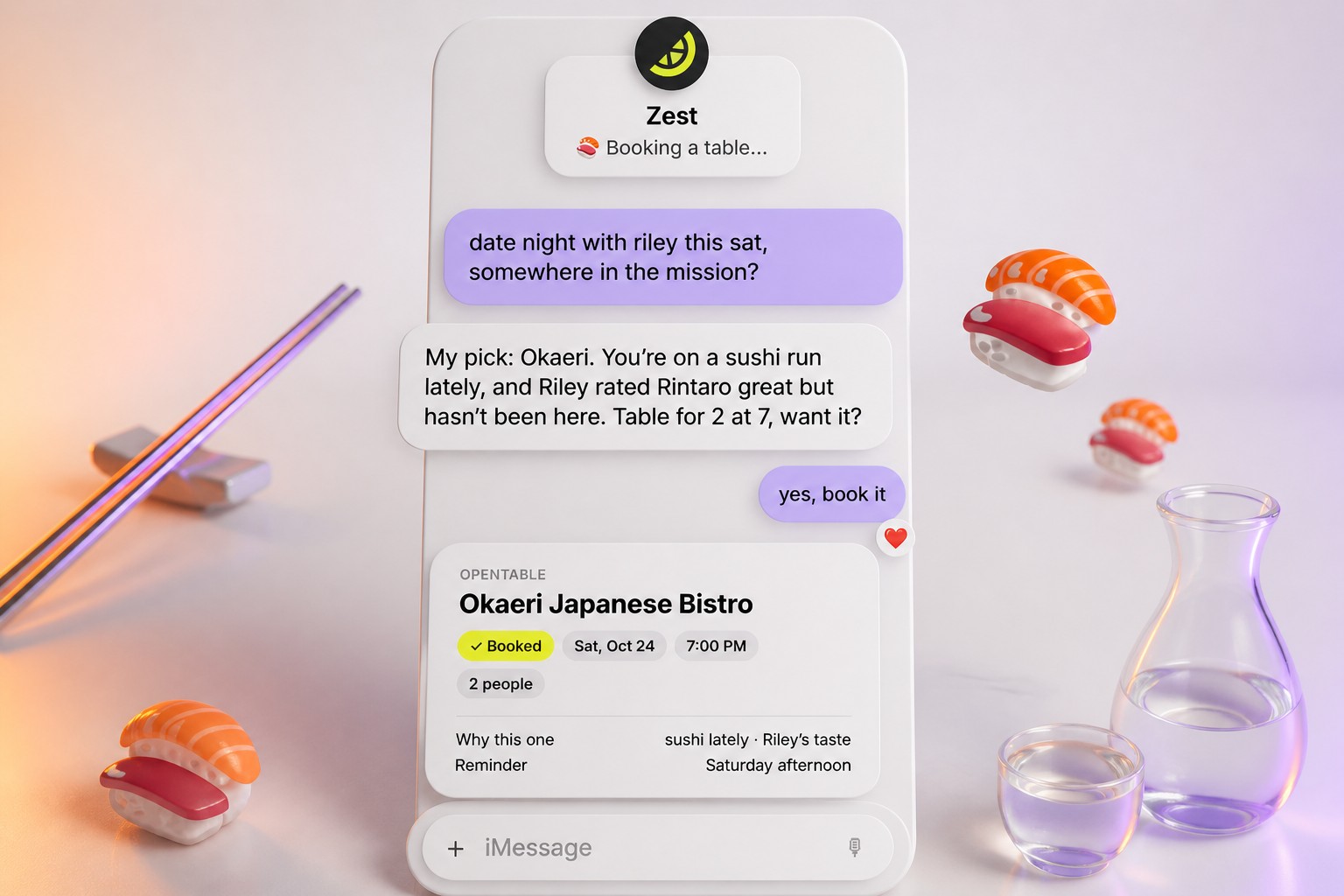
Recommendations from past visits
Founded in November 2024, Zest raised $1.8 million in seed funding from Alexis Ohanian of 776 and Steve Jang of Kindred Ventures.
The app connects to users’ bank cards through Plaid, using transaction data to infer dining preferences. Zest says it uses only food and drink transactions for personal cards and restaurant lists. It recommends places in users’ home cities and when they travel.
Now users can send those requests by text to Zest at (212) 470-6067. The concierge can consider cuisine, mood, occasion, dietary restrictions and neighborhood; users can also ask about a restaurant’s crowding or Wi-Fi, or request a menu.
For groups, the agent can account for everyone’s tastes, suggest a restaurant and let participants vote in the chat. They can then book without leaving the conversation. Reservations are available through OpenTable, Resy and SevenRooms.
TechCrunch’s tests found that the AI generally did well at recommending new places based on the reviewers’ tastes and constraints, including time of day, group size and location. Booking elsewhere is not new; Zest’s pitch is that people can compare options and check available times through an ongoing conversation.
The business behind the chat
Zest began testing the concierge last month, then delayed the launch until it had added reservations. Founder and CEO Mario Gomez-Hall says the agent is now the product: instead of starting with questions, it can use places a person has already visited, along with their friends’ histories, to get a quicker read on their tastes.
Reservations and food ordering are the company’s first planned routes to revenue, Gomez-Hall said. Zest currently books through OpenTable and Resy; food ordering is planned for later. The company is also considering recommendations beyond restaurants, including shops and other venues.
I think the key test is not whether the agent can produce a plausible shortlist, but whether its transaction history makes its suggestions noticeably better than a general-purpose assistant’s. The announcement gives no evidence yet about how often people book through Zest or whether the service can turn a few thousand users into a larger audience. Its advantage depends on having useful history; its business depends on making that history matter at the point of decision.
Daily AI news
Every day we pick what actually matters in AI and explain it plainly — no hype, no filler. Subscribe if you want to follow where the industry is going.
Only what matters — every day
Follow on X