
When Generation Becomes a World Model
AI can now create convincing scenes: objects move, cameras glide through rooms, and characters interact. But a polished video doesn’t mean the model understands how the world it depicts works. A ball might disappear behind a character and reappear somewhere else. The result can look impressive while failing to preserve the scene’s state or account for the consequences of actions.
The article proposes a key distinction between image generation and world modeling: a system must preserve the environment’s state and update it in response to actions and new observations. The authors also introduce WorldFoundry, an open infrastructure for running and comparing different types of models under shared rules.
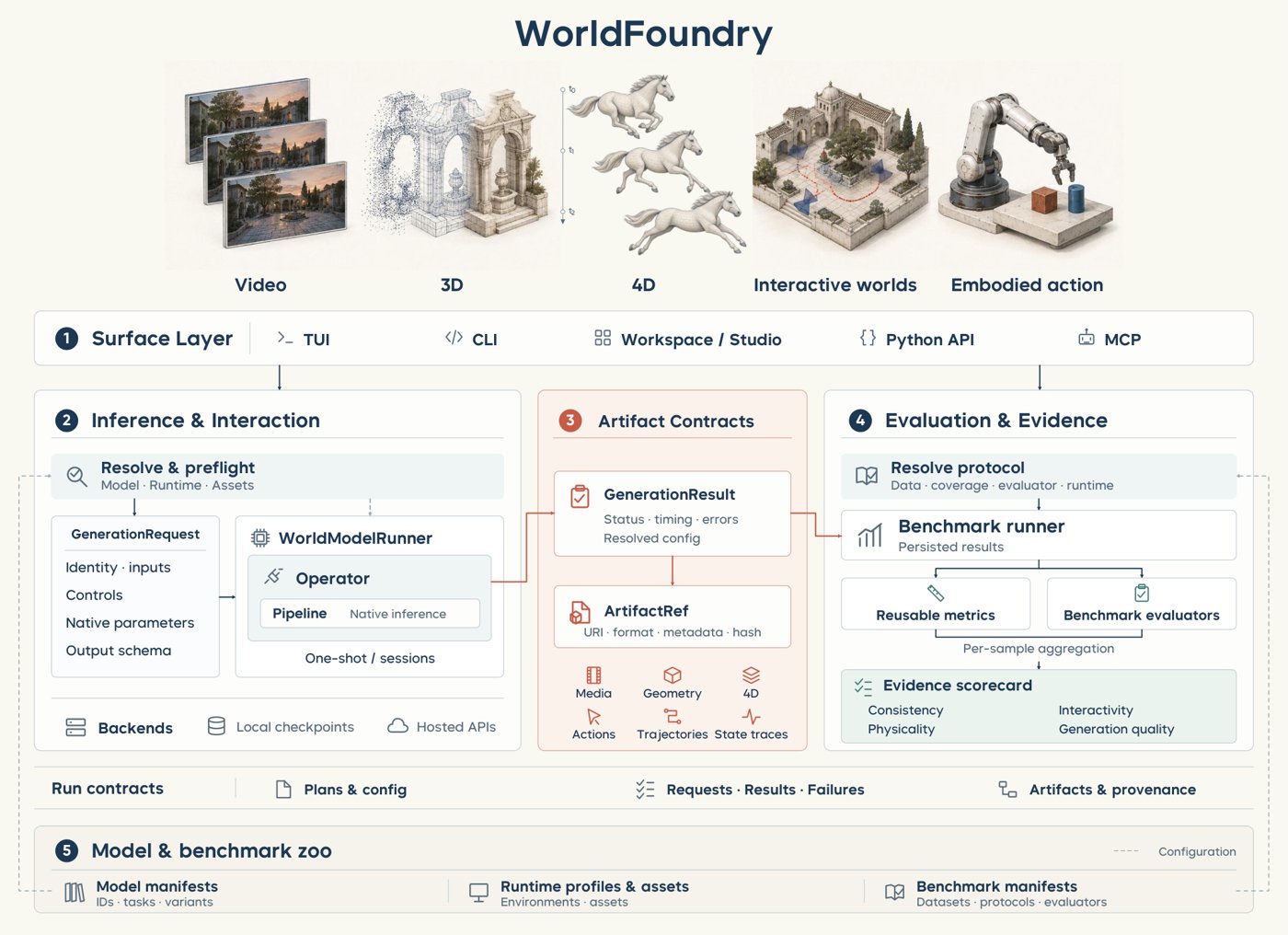
WorldFoundry brings model execution, result storage, and evaluation together in a single reproducible workflow.
What Makes a World Model
Generative models are often judged by how realistically they produce a single frame or video. But appearance is only part of the task. A model might depict a cup falling in a physically convincing way without representing that it broke or that shards are now scattered across the table.
The authors define a generative world model as a system that builds a representation of its environment from a history of observations, retains that representation, and updates it in response to actions. It should then predict what happens next. New observations, in turn, refine its representation.
Memory matters here not in the everyday sense, but as part of how the model works. If an object is affected by an action, that should constrain future predictions. And when the model observes a new scene state, it should take that into account in subsequent steps. When these processes form a feedback loop, the system does more than generate similar-looking images: it tracks changes in the environment.
The authors describe the operation of these systems in terms of three functions:
🟠 State estimation: The system infers how the environment is structured from observations and their history.
🟠 Forecasting: It predicts how the environment will change on its own and in response to external factors.
🟠 Action response: It generates possible futures based on what a user or another agent does.
These functions don’t imply a single internal architecture. Systems can represent state in different ways and produce different outputs: video, a 3D scene, a sequence of actions, or an answer to a control task. But shared functional questions make it possible to compare them without requiring every model to work the same way.
Why a Pretty Picture Isn’t Enough
The difference between a generator and a world model becomes clear when you test cause and effect. Imagine opening a virtual door. A model that tracks the scene’s state should continue from the door’s open position. If the door is closed again after the next action, the system hasn’t retained the result of the intervention.
That’s why the authors distinguish visual plausibility from a closed interaction loop. The first measures how convincingly a system generates observations. The second asks whether it can maintain state, account for actions, and revise its representation based on new information.
This distinction matters when assessing progress. A benchmark that checks only frame quality may miss the fact that a model forgets previous actions or breaks causal relationships. In video, objects might lose their properties between scenes. In robotics, a model’s prediction might no longer match what happens after a command. In interactive environments, the effects of actions might not persist from one step to the next.
The task is especially challenging because systems use different formats and execution procedures. Some take video as input; others work with scene geometry or actions. They may rely on different dependencies, data-preparation methods, and evaluation procedures. When every team runs models its own way, results are hard to reproduce and compare fairly.
What Is WorldFoundry?
WorldFoundry is an open infrastructure for running and evaluating models that work with video, 3D and time-varying scenes, actions in an environment, and interactive worlds. The authors aim to bring model and benchmark discovery, environment and resource setup, query execution, result storage, and result inspection into a single workflow.
The system doesn’t force models into a common format. Instead, each task type uses adapters that preserve the inputs, outputs, and execution rules of the specific model. This makes it possible to work with different systems in one framework without erasing their differences.
The practical workflow consists of reproducible runs. A model’s description specifies its dependencies, data, and interfaces. Once run, its outputs are saved as files in specified formats. Evaluations are then linked to those files, so users can check what a score is based on.
One important detail is the distinction between three separate claims: a model says it supports a task, its runner is technically ready, and its performance has been validated through evaluation. These aren’t the same thing. A listing in the catalog, for example, doesn’t prove that a model has passed the relevant benchmark. And a successful run doesn’t mean its predictions are accurate.
What Data the Platform Collects
The current WorldFoundry catalog lists 270 models, 74 benchmarks, and 62 metrics. The authors also note that they tested model runners end to end using the documented examples. This confirms that a system can carry out the specified procedure in the tested configuration; by itself, it doesn’t prove that the model is superior or performs well across all tasks.
These figures show the platform’s scope, but they don’t answer the question of which model is best. Useful comparisons require both the results and details about how they were obtained. WorldFoundry links evaluations to saved files so each result can be traced back to a specific run and its settings.
This approach draws an important distinction between readiness to run and validated capabilities. The catalog helps users see which systems are included and how to run them. Evaluation records should show exactly which properties were tested. Together, these features make results easier to reproduce, but they don’t remove the need to choose benchmarks carefully and check that they measure what they’re meant to.
What Changes for Researchers
A shared infrastructure can make comparisons clearer. Instead of building a separate wrapper for every project, researchers get a common way to describe runs and store results. That makes experiments easier to repeat and helps distinguish execution errors from a model’s poor performance.
The benefits go beyond convenience. If systems are evaluated not only on image quality but also on how well they maintain state and respond to interventions, their limitations become easier to pinpoint. One model might represent scene geometry well but struggle to predict how it changes. Another might generate convincing video but fail to support interactive control. Shared concepts make it possible to describe these differences without reducing them to a single score.
Still, WorldFoundry is infrastructure for measurement—not proof that existing models have become full-fledged world models. The catalog shows that systems can be run in a shared environment and that evaluations can be linked to data. But the quality of those measurements depends on the tasks and metrics chosen, and on how thoroughly the tests cover interaction with a changing environment.
Conclusion
A convincing video or scene isn’t enough to call a system a world model. It must preserve the environment’s state, account for the consequences of actions, and update its predictions based on new observations. That’s what separates generating individual images from modeling a process that unfolds over time.
WorldFoundry offers shared infrastructure for running and evaluating diverse systems. Its goal is to make comparisons reproducible and connect evaluations to specific results. If these tests cover not just appearance but also state persistence, causal relationships, and responses to actions, progress in world modeling will become easier to measure.
Read next
 How AI Can Enhance an Individual’s Intelligence
 FrontierPhysics: Let’s see whether AI agents can make discoveries
 How AI Chooses the Right Model for Each Task
 CaPtain: How to control a robot using a small AI model
 WorkFactory: Hundreds of thousands of professional tasks helped train
 How AI Agents Learn General Skills Across Different Tasks
 How can you tell that an AI agent is doing the task incorrectly?
 How an AI agent can master a new skill through practice using the Socratic method
 How an AI agent improves interfaces on its own
 How AI Predicts Brain Activity
 An AI agent doesn’t need ready-made answers to get better.
 How an AI agent changes without retraining the model
AI reviews in simple way
Every day we read fresh AI papers and retell the essentials in plain human language — no hype, no fluff. If you want to see where AI agents are heading before everyone else, subscribe.
New reviews — every day
Follow on X