
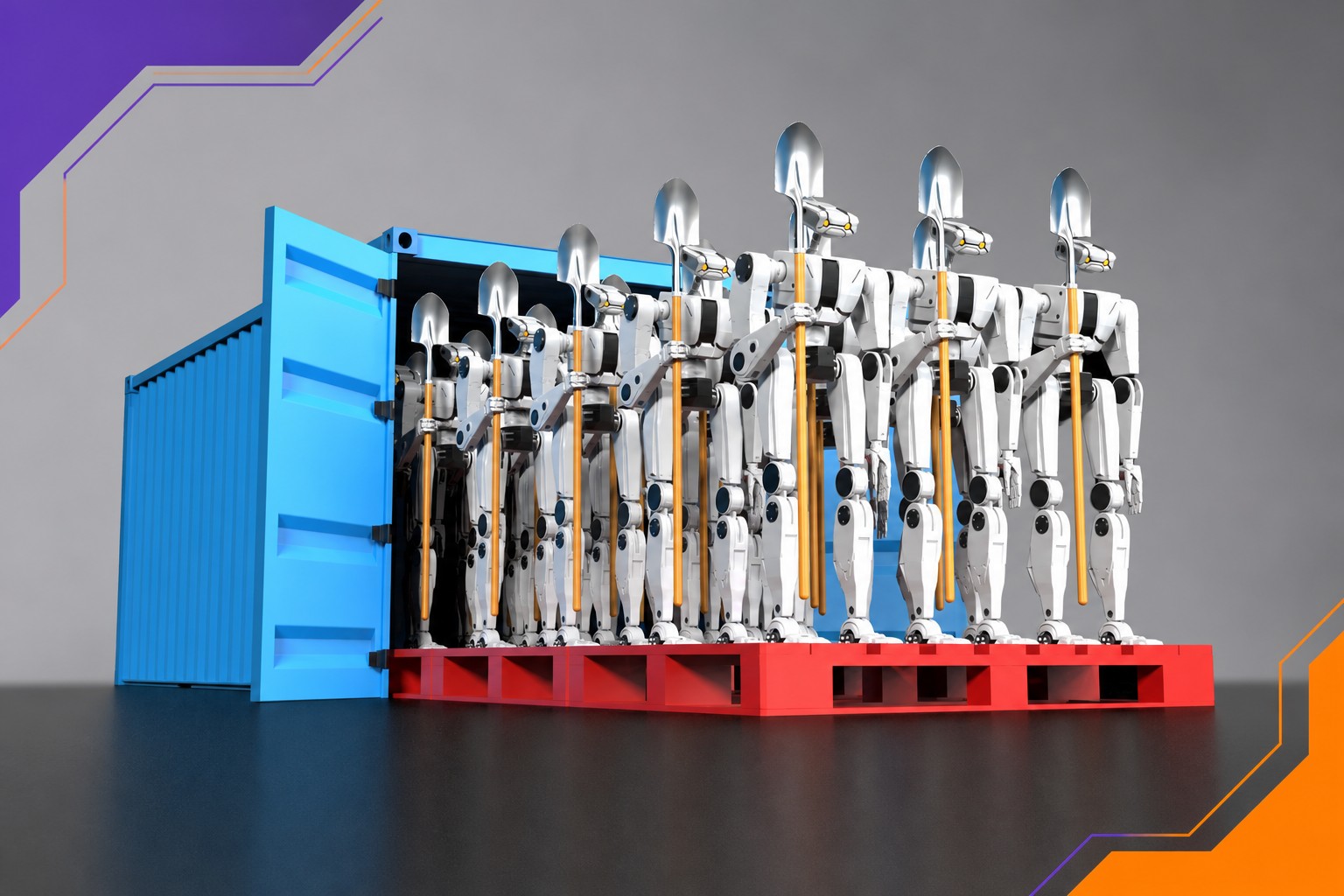
The humanoid robot industry has raised hundreds of millions of dollars at billion-dollar valuations on the promise that it will change the nature of work within a few years. The production targets match that promise: Tesla has said 5,000 Optimus units in 2025 and at least 50,000 in 2026, Figure expects to reach 100,000 robots a year by 2029, and Agility Robotics runs an Oregon plant rated above 10,000 a year. The deployment numbers do not match it. Even the industry's most successful companies have placed a handful of robots into tightly controlled pilots.
Agility itself expects to ship "hundreds" of Digit robots in 2025 — a few percent of what its own factory can build. Bank of America Global Research forecasts 18,000 humanoids shipped worldwide in 2025, which would make Tesla's target alone more than a quarter of global supply. Morgan Stanley Research goes further out: more than 1 billion humanoids in service by 2050, and a $5 trillion market. (This reporting appeared in an October 2025 print issue under the headline "Why humanoid robots don't scale," and the 2025 figures are targets as stated then.)
Manufacturing is not the binding constraint. Around 500,000 industrial robots were installed worldwide in 2023, and if a humanoid is roughly equivalent to four industrial arms in component terms, existing supply chains can absorb even the most optimistic near-term plans. The 2050 forecast is a different object entirely: a billion units over 25 years averages 40 million a year, eighty times the entire annual industrial robot installation rate. That is not a scaling plan, it is a placeholder for one.
Melonee Wise, until this month chief product officer at Agility Robotics, puts the hard problem on the other side of the ledger. Building the robots will likely be the easiest part of scaling. The problem is demand: nobody has yet found an application for which a single facility would need several thousand humanoids. That matters because large deployments are the only realistic path to growth for a robotics company — onboarding each new customer can take weeks or months, so a business built on dozens of small installations does not compound. The alternative the industry appears to be betting on for the medium term is a few hundred machines that each do ten different jobs.
Which returns the question to AI, and to an assumption that runs through the sector: that fast progress in models will automatically produce general-purpose robots. How that happens, when, or whether, is unresolved. Wise's read is that many in the field hope to solve the problem with AI alone, while today's AI is not robust enough to meet what the market actually requires — and what it requires is unglamorous. Battery life. Reliability. Safety.
The battery is the most legible of the three. A robot that spends most of its time charging is not doing work. The next version of Agility's Digit will carry up to 16 kg, and its large backpack holds a battery with a 10:1 work-to-charge ratio: 90 minutes of operation, 9 minutes to a full charge. Thinner humanoids from other companies necessarily trade something away to keep that form factor.
Read the 90 minutes carefully, though, because Agility does not spend it. In practice Digit will likely charge for a few minutes after every 30 minutes of work; the remaining 60 minutes is reserve, held back for events in the work area that force the robot to stop. In logistics and manufacturing, Agility's target markets, those events are common. Without the reserve, robots would run flat mid-task and need charging by hand — and as Wise notes, nobody wants to deal with a few hundred 100 kg machines stranded on a floor. The specification says 90 minutes. The operating assumption is 30.
Reliability is where the numbers get expensive. A plant running at 99% accumulates about five hours of downtime a month. Wise says a stopped production line can cost tens of thousands of dollars per minute, which makes those five hours worth millions — so industrial customers ask for more nines, on the order of 99.99%. Agility has demonstrated that level in specific scenarios, by Wise's account. For general-purpose work it has not been shown at all, and general-purpose work is precisely what the valuations are priced on.
Safety closes the last exit. Self-driving cars and drones scaled quickly in part because regulation was immature; humanoids do not get that opening, because factories are already heavily regulated and a humanoid is treated as one more piece of industrial equipment. Dedicated standards are being written on top of the general ones. Matt Powers, deputy director of autonomous systems R&D at Boston Dynamics, says the company is helping develop an International Organization for Standardization standard for dynamically balancing legged robots, and that Boston Dynamics is glad leading companies including Agility and Figure have joined the effort to articulate why their systems can be considered safe.
The technical difficulty there is real and specific: the conventional emergency stop is cutting power, and a robot holding its balance in motion falls when you cut power, which can make the situation worse. There is no simple fix. Boston Dynamics' initial strategy for Atlas is to keep the robot out of situations where a normal power cut would create additional risk — start with low-risk tasks, widen the envelope as confidence in the safety systems grows. Powers thinks that incremental approach is what produces results.
In practice, low risk means keeping humanoids away from people. And this is where the sector's story eats itself: the tighter the restrictions on which tasks a robot may perform and where it may walk, the harder it becomes to find work for it that is worth paying for. The most valuable jobs in a warehouse are the ones humans are standing in.
Then there is the question underneath all of the others, which is whether legs earn their complexity. The theory is that dynamic balance lets a robot move through cluttered human environments the way a human does. The demonstration videos mostly show robots that are nearly stationary, or repeating short moves across flat floors. Those clips are presented as the first step toward human mobility, and they may be. But for the near and medium term, more reliable, more efficient and cheaper platforms already exist for exactly those scenarios: robots with arms, on wheels.
What is missing from every forecast quoted here is any connection to any of this. The 18,000 units, the billion robots, the $5 trillion — none of them is conditioned on battery chemistry, on reaching four nines outside a demo, or on an ISO standard with no publication date. They are demand curves drawn for a capable, efficient, safe general-purpose humanoid that does not exist yet. Safe and reliable humanoids may one day reshape labor markets. But every constraint that makes one deployable today — flat floors, short trips, low-risk tasks, distance from people — describes a workspace that a wheeled machine with arms already serves. The forecasts assume those constraints lift. The engineering assumes they hold.