
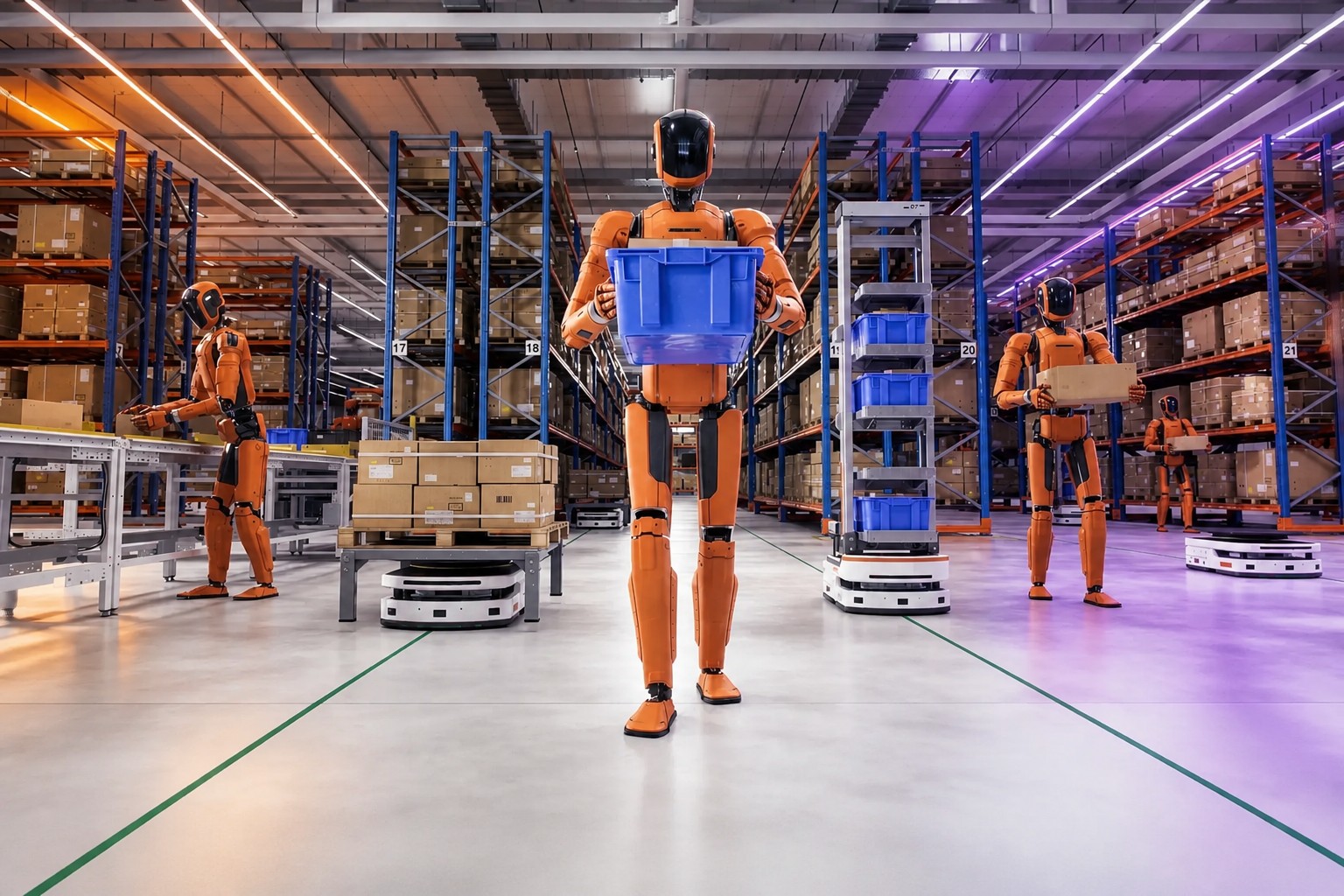
Workers at Hyundai's plant in Ulsan held a partial strike this summer with one demand: humanoid robots cannot be introduced without the consent of employees. No humanoid robot works at the plant. Hyundai intends to begin deploying them in 2028 and to put them on component assembly by 2030. This is thought to be the first time anywhere that plans to deploy robots for human work helped trigger a labour dispute, and the striking detail is the tense — the workers walked out over a machine that is still six years and one procurement cycle away.
The robots in question are Atlas units from Boston Dynamics, which Hyundai bought in 2020. The Seoul Economic Journal reports that banners appeared on Ulsan streets shortly after the plans were announced, demanding that human jobs not be handed to robots. Hyundai has said it plans to deploy 25,000 Atlas robots.
That pairing — a 2028 start and a 25,000-unit target — is the whole dispute compressed. The union is not bargaining over a pilot. It is bargaining over the return case on a multi-billion-dollar acquisition, at the only moment when the terms are still open. Organised labour spent the last three decades learning that automation is negotiated after installation, when the leverage is gone. Ulsan is what it looks like when that lesson is applied early.
The industries these machines are heading for have no idea how to absorb them. No country has passed laws setting rules or protections for robots that move around a factory floor next to people. The US Occupational Safety and Health Administration has not finished work on an official ISO standard for mobile robots capable of keeping their own balance — machines that are not bolted to the floor, unlike the robotic arms that have worked in car plants since the 1960s. No company has publicly put forward a convincing plan to cushion the effect on the people whose jobs the robots will do.
So the Ulsan union is starting from nothing. It has to negotiate the terms under which humanoids take over roles people currently hold, for a class of machine no regulator has yet defined, with no precedent to cite and no statute to lean on. Whatever agreement emerges, corporations everywhere will read it closely, because most of them will face the same negotiation soon. Hyundai will presumably concede as little as it can, to get the most out of what it paid for Boston Dynamics.
The case for humanoids is real and should not be waved away. They can take on repetitive, physically punishing and dangerous work, and free people for tasks better matched to human capability. The productivity upside is the reason anyone is spending this money. The problem is one of speed: the technology can move faster than society can absorb what it does, and regulation, labour agreements and worker protections are all behind.
Here is the part I think is underweighted. The demand at Ulsan is consent, not compensation. That is a far more expensive thing to grant, and a far more durable one to win. Severance packages and retraining budgets are line items; a consent clause is a veto, and it converts every future deployment decision into something the union prices. If Hyundai signs anything resembling one, it will have created the first private labour law for humanoid robots — written bilaterally, before any legislature got to the subject, by the party that spent billions on the machines. Every transformative technology, from aviation to nuclear power to pharmaceuticals, eventually acquired rules governing its risks to people and society. Humanoids have none yet, and companies are deploying anyway, which leaves the agenda to be set by whoever expects to profit from it.
What nobody in this dispute has said out loud is which jobs are at stake. Hyundai's plan names a date and a unit count. The union's demand names a procedure. Neither names a single role that a robot is meant to take over, or how many of the people currently doing it are expected to still be there in 2030. That absence is convenient for both sides right now, and it is the number on which any real agreement has to turn.
Putting humanoids into the workforce is a political and social question at least as much as an industrial one, and those voices have barely been heard. The default posture, as with previous transformative technologies, is wait and see — except that here the consequences look larger and more disruptive. Simply slowing deployment is unlikely to help; it postpones the reckoning rather than resolving it. Governments and the public need to move at something closer to the speed industry is already moving at.
The Hyundai workers may be the first to picket, but millions in manufacturing, logistics, retail and healthcare are behind them, and if they see no protection for their interests they will say so on picket lines and at elections. That path ends in restrictions and regulation that blunt the productivity case the industry is building its numbers on, and in a collapse of worker trust in the corporations they expect to defend their livelihoods. Ulsan will settle its contract long before any parliament writes a rule — which means the template for humanoid labour relations is being drafted right now, in private, by a company with 25,000 robots on order.