
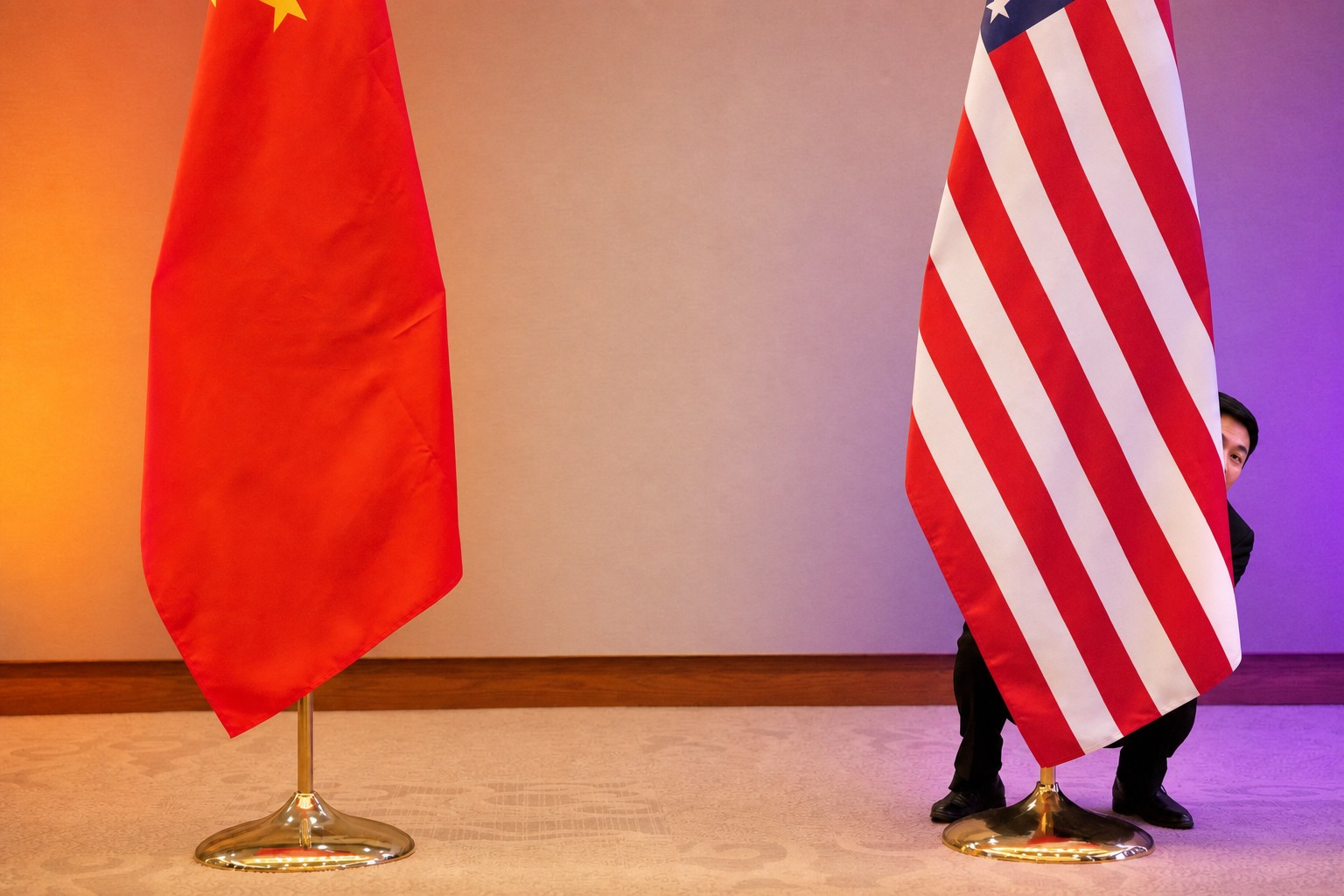
In July and August Washington tightened control over advanced foreign-made robotic systems and imposed steep tariffs on imported drones and drone components, both on national security grounds. The drone duties take effect this month; the additional tariffs on components arrive in 2027. Over the same half-year, Counterpoint counted 22,000 humanoid robots shipped worldwide, the overwhelming majority of them built by Chinese companies. The new barriers protect a slice of the American market. They leave untouched the manufacturing scale and the cost structure that produced those shipments.
The Federal Communications Commission's covered list, created in 2021, started as a telecom and surveillance instrument aimed at Huawei, ZTE and Hikvision. Foreign-made drones were added later. Advanced robotic devices were added recently. Read as a sequence rather than as a single policy, the list works less like a doctrine than like a running tally of the categories in which Chinese manufacturers became good enough to worry about — each entry arriving after the market position it addresses had already formed.
The concentration on the other side is extreme. The five largest humanoid makers by shipments — AgiBot, Unitree, Galbot, UBTECH and Leju Robotics — are all Chinese, and together they accounted for 86% of global shipments in the first half of 2026. American manufacturers operate at far smaller scale, said Soumen Mandal, chief analyst at Counterpoint Research.
That lead compounds. Lower prices let Chinese firms put more robots into service, and more robots in service generate more data from real use. That data improves the technology, and rising production volumes push costs down further, explained Ankur Saxena, investment director at TDK Ventures. Mandal added a second mechanism: Chinese manufacturers are cutting costs by pulling more components and processes in-house and by drawing on the country's existing industrial base. Unitree is developing more of its own components. Automakers such as XPeng can carry chip and vehicle manufacturing experience into robotics.
Saxena's division of the two countries' strengths is the clearest framing anyone in the story offers. The US leads in advanced AI, software and semiconductor design. China leads in manufacturing scale, supply chain depth and cost. Robotics, he noted, is unlike semiconductors: it does not rest on a single technology that one country could bring under control. And sanctions, in his view, cannot route around a cost curve — closing that gap requires building production, and the US has not begun the decade-scale investment that would take.
The drone market already shows what a fragmented industry looks like in practice. Benzion Levinson, founder and chief executive of the Virginia drone maker Heven AeroTech, describes a split into two ecosystems: a US-led market of NDAA-compliant American systems, and a China-led market of inexpensive mass production. Western manufacturers are unlikely to beat Chinese firms at the low end of consumer drones, where price remains the deciding factor, so American and allied companies may concentrate on long-range autonomous systems for defense and critical infrastructure, where security requirements outweigh cost. The next competitive line, Levinson argues, may run not through the aircraft but through the technologies that make them work and the equipment they carry — he points specifically to battery limits, and expects energy systems to become a principal object of rivalry as drone capability grows.
Agility Robotics backed the FCC's July decision, saying it lets the US address security concerns around advanced foreign-made robots before those machines become deeply embedded in the American market, as happened in drones. The company pointed to Digit, its humanoid, which is designed and assembled in the US. It also urged that access to the tools and technologies robotics research depends on be preserved.
That last clause is the most honest sentence in the whole debate, and it is doing a lot of work. A company asking for protection at the product layer while asking to keep importing the inputs is describing the actual shape of the problem: the barrier is being built at the point where it is cheapest to build, not at the point where the dependency lives. Tariffs and covered lists are available this year; factories are not. My reading is that these measures should be understood as market-share policy rather than industrial policy, and the two get conflated because they arrive in the same press release. Nothing announced in July or August adds a unit of American humanoid production capacity. The 86% figure is not a number that regulation moves.
The question the announcements are quiet about is where the displaced supply goes. Analysts and executives who spoke to TechCrunch expect not a clean US–China partition but a more fragmented global market. Chinese firms are already targeting price-sensitive markets in Europe, Southeast Asia, Latin America and the Middle East, where labor shortages are severe, Mandal said. He expects humanoid makers to follow the path of Chinese EV manufacturers: scale at home, then export, then build local production abroad. The first markets are likely to be countries with labor shortages and shrinking populations, particularly in industrial work with repetitive operations. A large domestic market plus that expansion path means losing US access is a constraint on Chinese robotics, not a ceiling.
Saxena's alternative is a diversified allied supply chain rather than a fully domestic American one. Other parts of Asia offer openings: Japan has decades of industrial robotics and precision manufacturing, South Korea is strong in electronics, batteries and automobiles, Taiwan holds a central position in semiconductors. None of them can simply replace China — Chinese components are too deeply embedded in the global robotics industry. Mandal sees those manufacturers occupying a middle tier between cheaper Chinese robots and more expensive American offerings, and names South Korea's Hyundai, which owns Boston Dynamics, and Japan's Toyota among the automakers moving into humanoids with experience in vehicles, manufacturing and autonomous systems.
Yang Fan of the California agtech startup Beagle Technology told TechCrunch that robotics will likely become more regional, with companies designing machines around the labor markets, working conditions and customers of their own countries. Chinese firms build for China and neighboring markets; American firms build for North American industries. The outcome that description points to is not two rival robotics industries but several regional ones, with Chinese companies competing on cost and scale across much of the world, American and allied manufacturers holding the ground where security requirements dominate, and Japanese, Taiwanese and South Korean firms working the space in between. Protection of the US market is compatible with all of that. What it is not compatible with is the assumption that the American market is where the industry's volume will be decided.