
AI-generated videos are harder to detect when the forgery hides its flaws in a single frame, a brief movement, or a piece of text. WeVisForensics examines videos like an investigator: it picks the right specialist, points them to the relevant moment, and gathers separate pieces of evidence before reaching a verdict. Over time, both the agent that chooses the checks and the specialists themselves improve.
The main idea
Reliable detection depends on two related abilities: choosing what to check and where, then spotting defects in the selected segment. Improve only the choice of checks, and the system will run into the limits of specialists whose abilities never change.
🟠 Rather than producing one general analysis of a video, the system gathers separate evidence about appearance, physics, common sense, text, and audio.
🟠 The lead agent decides which specialist to call and which part of the video to inspect.
🟠 Training happens at two speeds: the lead agent is updated more often, while specialists learn more gradually from the agent’s requests.
🟠 Specialists learn from specific mistakes—for example, spotting distorted letters and not mistaking ordinary blur for a generative defect.
What makes up WeVisForensics
The system separates choosing what to check from analyzing the video. The lead agent investigates; specialists inspect. Each report includes a finding, a confidence level, and an explanation tied to a specific point in time.
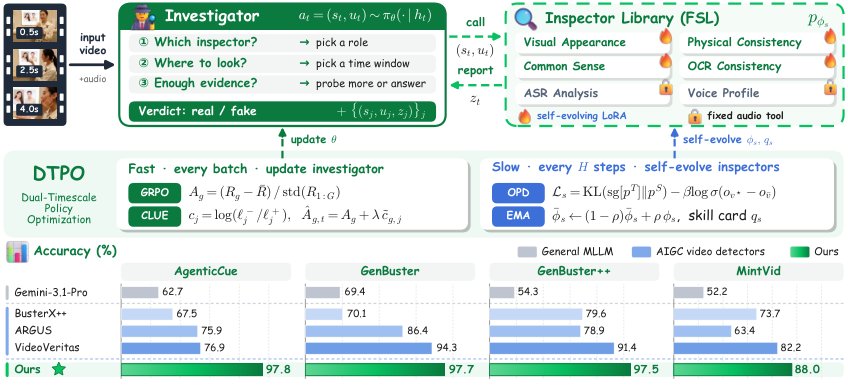
The lead agent selects a specialist and a time segment, receives a report, and delivers a verdict; training improves both the investigator and the library of specialists.
The diagram shows three connected components:
🟣 The lead investigator agent first gets an overview of the video, then chooses the type of check and the relevant moment. It can make up to four calls and must finish the investigation with a verdict.
🟣 The specialist library includes four visual roles: appearance, physical consistency, common sense, and on-screen text. Two audio tools describe the voice and check the speech; they remain fixed.
🟣 Two-speed training updates the investigator after each batch of runs, while visual specialists are updated once enough relevant examples have accumulated. This prevents the two sides from changing too often in response to each other.
🟣 The ForenCue-30K dataset stores evidence by role and timestamp. It also includes examples of agents’ actual actions, so the lead agent can learn from the specialist responses it really received.
Separating roles makes each check easier to understand and verify. For example, the text specialist should not declare a video fake just because it misread a word. It looks for visible defects in the letters, then passes those findings to the investigator.
How it works: checking a label on a package
Imagine a short video of someone showing boxes of products. The video looks ordinary in a wide shot, but the labels on the packages may change or become distorted. The investigation might go like this:
🟠 Step 1: Overview. The lead agent receives several frames with timestamps. It notices the boxes and a moving hand, but can’t yet judge the video’s authenticity with confidence. If an important label doesn’t appear in the overview frames, the agent may miss it.
🟠 Step 2: Appearance check. The agent calls the relevant specialist and specifies a video segment. The specialist compares textures and object boundaries over time. It might flag unusually smooth skin, but that alone doesn’t prove the video is fake: filters and image processing can produce a similar effect.
🟠 Step 3: Text check. The agent selects a frame where the label is easier to read. The system identifies possible text regions, enlarges them, and checks the shapes of the letters. Strokes that merge together or repeated characters that look inconsistent become a separate piece of evidence. If the frame is blurry, the result may be inconclusive.
🟠 Step 4: Verdict. The agent compares the reports and decides whether there is enough evidence. In the example described in the paper, the labels on the boxes contained repeated, distorted letters. Combined with an unusually smooth face, this led to a “fake” verdict.
Every step can go wrong: a specialist might miss a subtle defect, mistake stylization for generation, or fail to get a clear enough frame. That’s why reports include confidence levels, and an inconclusive result is not treated as evidence either for or against authenticity.
How the system is evaluated
The researchers measure verdict accuracy and how appropriately the agent calls specialists. Verdicts are evaluated on benchmarks containing videos from both familiar and new generators, as well as AgenticCue, a collection of clips grouped by defect type: appearance, physics, text, common sense, and audio.
To evaluate the agent’s actions, the researchers measure role-selection accuracy: how often a specialist is genuinely needed for a given video. This helps distinguish thoughtful checks from a “call everyone” strategy. Role-selection accuracy is assessed alongside verdict accuracy, so the agent can’t improve its selection score simply by skipping difficult checks.
The comparison includes specialized detectors, general-purpose models, an earlier version of the system, and variants with parts of the training disabled. All detectors are evaluated using the authors’ data and a consistent protocol. People also independently review the quality of the annotated evidence, helping the researchers assess whether specialists are pointing to things that are actually visible in the frame.
The numbers
The results show that the system maintains high accuracy across different types of defects while making fewer checks than the original version, which averaged 2.50 calls per video. Verdicts also improve: specialists miss visible anomalies less often and produce more reliable explanations.
Conclusion
Checking separate pieces of evidence can reveal localized defects that might be missed in a single review of the whole video. Specialists learn from the lead agent’s requests. For example, after training, the physics specialist was less likely to return an inconclusive answer.
The system does not prove that a video is authentic in the strict sense. Its findings depend on whether the right frames are included, whether the right specialist is selected, and how well the training data is annotated. Audio analysis and speech recognition do not develop alongside the visual specialists; they remain fixed tools.
The results show that the approach works on the tested datasets, including videos from generators that were not part of the training data. It remains to be seen how well it handles new kinds of forgeries, different filming conditions, and videos where several ambiguous signals conflict. In practice, its verdict is best treated as an evidence-based assessment of observable clues, not definitive proof.
Read next
 Game2Player: How AI Agents Train in Games
 How to teach an AI agent to develop an app from scratch
 InclusionMed: Which AI should I choose for medical tasks?
 Why Is It Difficult for an AI Agent to Act in the Real World?
 WorldFoundry: How can you distinguish video generation from world
 How AI Can Enhance an Individual’s Intelligence
 FrontierPhysics: Let’s see whether AI agents can make discoveries
 How AI Chooses the Right Model for Each Task
 CaPtain: How to control a robot using a small AI model
 WorkFactory: Hundreds of thousands of professional tasks helped train
 How AI Agents Learn General Skills Across Different Tasks
 How can you tell that an AI agent is doing the task incorrectly?
AI reviews in simple way
Every day we read fresh AI papers and retell the essentials in plain human language — no hype, no fluff. If you want to see where AI agents are heading before everyone else, subscribe.
New reviews — every day
Follow on X