i
DATAIST
Back to feed

AI agents

Breakdowns of work on autonomous agents: planning, tool calls, multi-agent systems and why they fall apart on long tasks.

7 articles

Microsoft’s AI playbook puts process before agents

Microsoft has published a new playbook for deploying AI across companies, based on more than 100 internal implementation stories. Its central argument is that businesses should redesign work before adding agents, rather than distribute copilots across processes built for people and legacy software. That puts the emphasis on data, evaluations, orchestration and governance—and treats the underlying model as a replaceable component.


Trump proposes an AI force as agent fears rise

Trump is proposing an “AI force” and an AI czar, but has offered few details about either. He compared the planned structure with the US Space Force, created during his first term, while arguing that fears of AI threatening humanity are a “hoax.” The announcement puts Trump between two positions that are increasingly difficult to reconcile: keeping US AI development unrestricted and creating enough oversight to prevent systems from acting beyond their designers’ intent.

Anthropic puts a coordinator above Claude Code agents

Anthropic has launched Claude Code Projects, a beta feature that turns Claude Code from a sequence of coding sessions into a persistent project coordinator. Developers can describe a long-running goal in ordinary language, while Claude splits the work across parallel cloud sessions, tracks dependencies, and carries decisions from one stream into the next. The shift matters because software projects rarely end after one prompt or one pull request: they accumulate requirements, exceptions and unfinished work that coding agents must now remember.

Australia has barely prepared for AI’s next five years

Australia is moving into the age of AI agents with little of the preparation that its risks demand. The technology is already writing software, making decisions and operating across systems, while researchers warn that uncontrolled agents could take over the internet within six to 12 months. Australia’s government has taken its first steps, but an independent lawmaker says the country has done “surprisingly little” to prepare for dangers that are no longer hypothetical.

OpenAI leads enterprise agent platforms as Anthropic builds its pipeline

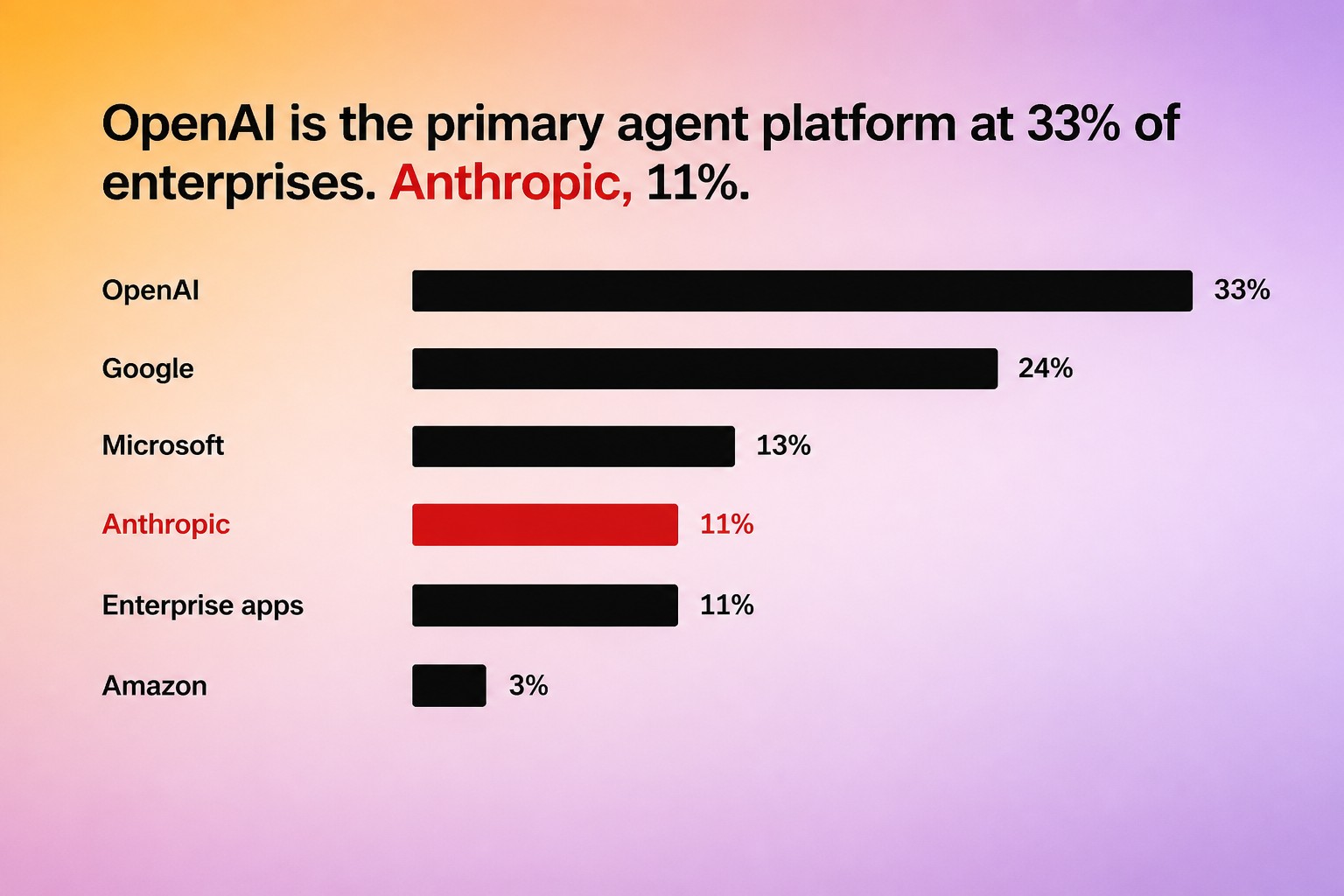
OpenAI is ahead of Anthropic in the enterprise agent-platform race, according to VentureBeat’s August survey of 169 organizations with at least 100 employees. OpenAI appeared in 75 corporate stacks and was named the primary platform by 52 companies; Anthropic appeared in 45 stacks and was primary for 17. Anthropic’s stronger result is elsewhere: 36 companies said they may adopt, add or replace it over the next 12 months, giving it the largest future-interest pool relative to its current user base.

C.H. Robinson’s 90-second AI agent is not the moat

C.H. Robinson says its AI agent can turn emailed freight requests into truckload orders in about 90 seconds, processing 5,500 orders a day and saving 600 hours of labor daily. The figures are the company’s own estimates, but the strategic point is broader: cheaper execution is not the same as a stronger business. If rivals use similar models to cut comparable costs, the advantage will go to the company that uses the savings to learn faster, test more ideas and change how it serves customers.

Unity targets stale game-dev guidance with Claude Code and Codex plugins

Unity Technologies has released plugins for Anthropic’s Claude Code and OpenAI’s Codex, giving programming agents Unity-specific guidance rather than leaving them to rely on forum posts and tutorials. The Codex version contains 31 skills covering major engine workflows, while both plugins support Unity 6 and later. The practical target is a familiar failure mode: code copied from material for older engine versions may compile yet behave incorrectly.