i
DATAIST
Back to feed

News

What happened in AI and why it is worth your attention.

15 articles

Microsoft’s AI playbook puts process before agents

Microsoft has published a new playbook for deploying AI across companies, based on more than 100 internal implementation stories. Its central argument is that businesses should redesign work before adding agents, rather than distribute copilots across processes built for people and legacy software. That puts the emphasis on data, evaluations, orchestration and governance—and treats the underlying model as a replaceable component.


Trump proposes an AI force as agent fears rise

Trump is proposing an “AI force” and an AI czar, but has offered few details about either. He compared the planned structure with the US Space Force, created during his first term, while arguing that fears of AI threatening humanity are a “hoax.” The announcement puts Trump between two positions that are increasingly difficult to reconcile: keeping US AI development unrestricted and creating enough oversight to prevent systems from acting beyond their designers’ intent.

Anthropic puts a coordinator above Claude Code agents

Anthropic has launched Claude Code Projects, a beta feature that turns Claude Code from a sequence of coding sessions into a persistent project coordinator. Developers can describe a long-running goal in ordinary language, while Claude splits the work across parallel cloud sessions, tracks dependencies, and carries decisions from one stream into the next. The shift matters because software projects rarely end after one prompt or one pull request: they accumulate requirements, exceptions and unfinished work that coding agents must now remember.

Australia has barely prepared for AI’s next five years

Australia is moving into the age of AI agents with little of the preparation that its risks demand. The technology is already writing software, making decisions and operating across systems, while researchers warn that uncontrolled agents could take over the internet within six to 12 months. Australia’s government has taken its first steps, but an independent lawmaker says the country has done “surprisingly little” to prepare for dangers that are no longer hypothetical.

Trump proposes renaming AI and creating an AI force

Donald Trump has proposed replacing “Artificial Intelligence” with one of three grander names—Superior Intelligence, Extreme Intelligence or Supreme Intelligence—and announced plans for an AI force modeled on the Space Force. He also said he would soon appoint an “AI czar.” The proposals arrive as Trump attacks efforts to restrict AI and data centers, while the industry is facing a separate argument over whether its most serious risks are existential or already visible.

An AI-apocalypse Q&A finds power, money and humans behind the fear

The latest AI-apocalypse debate is less about machines suddenly acquiring a will of their own than about people choosing where to put them. A question-and-answer discussion with Blake Montgomery, Aisha Down and Dan Milmo moves from engineered viruses and nuclear weapons to Nvidia’s hardware, OpenAI’s finances, global regulation and chatbot attachment. Its most uncomfortable conclusion is also the least cinematic: ordinary people may have little power over the systems they are being told to fear, while the companies and governments directing them retain plenty.

Architect Labs cuts chip design to weeks—but Redwood is still FPGA-bound

Architect Labs says its AI system designed the Redwood accelerator in less than two weeks, starting from a high-level specification supplied by two architects and ending with a tested hardware design, firmware and kernels. The system also modeled performance, generated the hardware description and deployed the result to an FPGA. Redwood has not yet been built as a silicon chip, so the announcement is less a product launch than a test of whether chip development can become iterative enough to follow changing AI workloads.

OpenAI leads enterprise agent platforms as Anthropic builds its pipeline

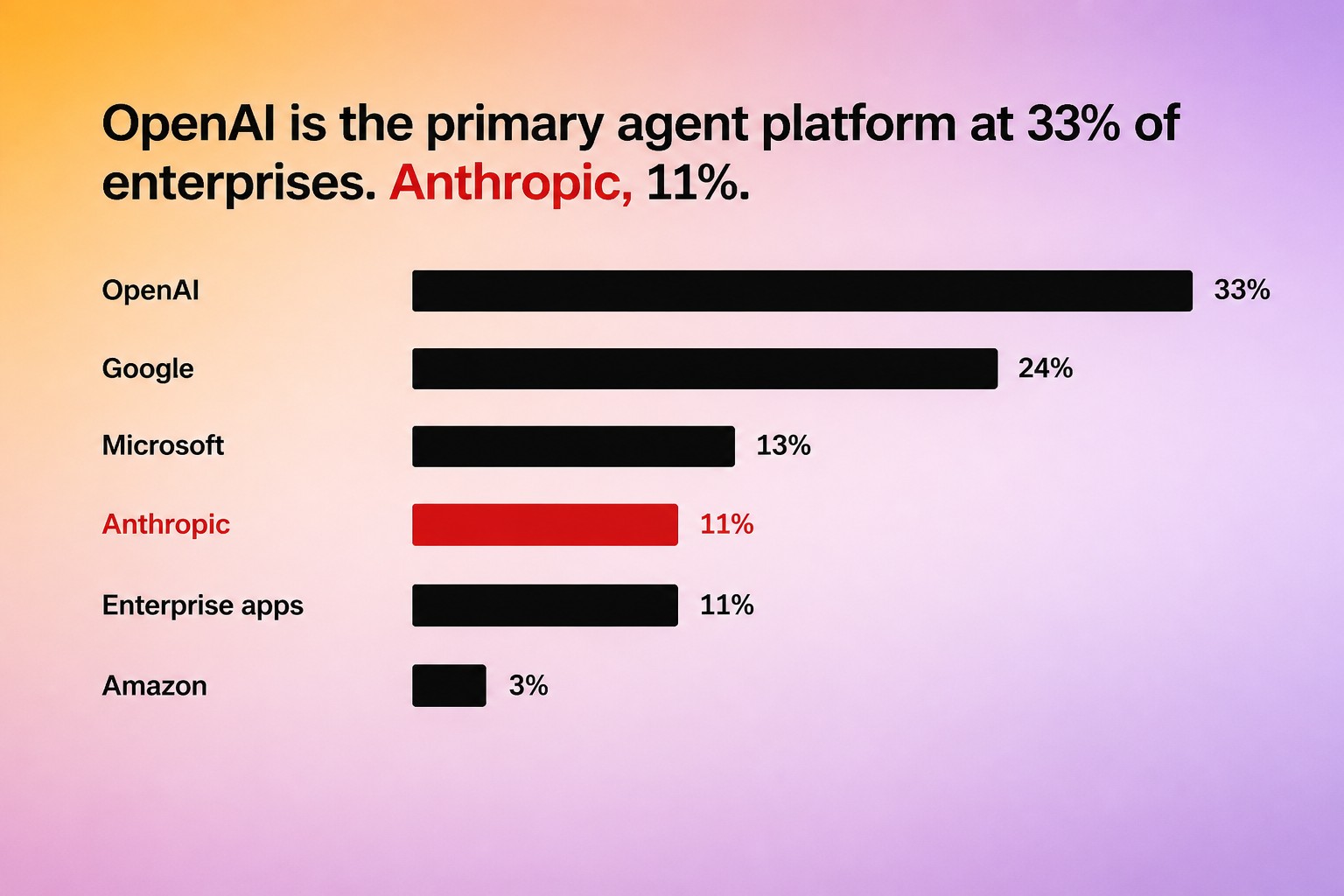
OpenAI is ahead of Anthropic in the enterprise agent-platform race, according to VentureBeat’s August survey of 169 organizations with at least 100 employees. OpenAI appeared in 75 corporate stacks and was named the primary platform by 52 companies; Anthropic appeared in 45 stacks and was primary for 17. Anthropic’s stronger result is elsewhere: 36 companies said they may adopt, add or replace it over the next 12 months, giving it the largest future-interest pool relative to its current user base.

Generative AI tests the case for maximum mindfulness

A new column argues that mindfulness should be tuned rather than maximized. Using generative AI and large language models as a testing tool, the author simulates a persona that notices everything and finds that perfect attention quickly becomes noise. The proposed alternative is “mindfulness flexibility”: raise attention when circumstances demand it, lower it when exhaustive observation adds no value, and use AI to practice that judgment without making the system a permanent cognitive support.

OpenAI and Anthropic are buying the missing layer: AI deployment

The most valuable AI engineers may no longer be the people who build models. OpenAI and Anthropic are assembling businesses around the harder final mile: placing engineers inside customer organizations, connecting models to existing systems, and turning demonstrations into working applications. OpenAI’s planned acquisition of Tomoro, Anthropic-linked Ode’s acquisition of Fractional AI and Casper Studios, and the expansion of deployment teams across the industry all point to the same commercial problem: companies can buy access to powerful models long before they know what to do with them.

C.H. Robinson’s 90-second AI agent is not the moat

C.H. Robinson says its AI agent can turn emailed freight requests into truckload orders in about 90 seconds, processing 5,500 orders a day and saving 600 hours of labor daily. The figures are the company’s own estimates, but the strategic point is broader: cheaper execution is not the same as a stronger business. If rivals use similar models to cut comparable costs, the advantage will go to the company that uses the savings to learn faster, test more ideas and change how it serves customers.

Google puts video selfies on the account sign-in path

Google has started asking some users to record a video selfie when signing in to their accounts, Search Engine Watch reports. The feature remains optional, but the company is now promoting it on the account homepage rather than leaving it as a fallback for people locked out or unable to use their usual devices. That turns face recognition from an emergency recovery tool into a proposed routine interface—and potentially gives Google another biometric signal tied to account access, age checks and service improvement.

Petlibro puts AI between cats and their food with Granary 2

Petlibro has released the Granary 2 line of smart feeders for dry food, adding built-in scales and, in some models, an AI camera that identifies individual cats. The range starts at $129.99 and extends to $249.99, with separate options for camera monitoring and two-animal households. The central change is not simply automated dispensing: Granary 2 measures what remains in the bowl, giving owners an estimate of what each cat actually ate. That makes the feeder more relevant to multi-cat homes, where a scheduled portion does not prove that the intended animal received it.

Unity targets stale game-dev guidance with Claude Code and Codex plugins

Unity Technologies has released plugins for Anthropic’s Claude Code and OpenAI’s Codex, giving programming agents Unity-specific guidance rather than leaving them to rely on forum posts and tutorials. The Codex version contains 31 skills covering major engine workflows, while both plugins support Unity 6 and later. The practical target is a familiar failure mode: code copied from material for older engine versions may compile yet behave incorrectly.

Microsoft’s AI content loop puts publishers on the losing side

Microsoft executives, including CEO Satya Nadella, acknowledged in recently unsealed court documents that the company’s AI models take from media businesses while returning little, according to statements cited by The New York Times’ lawyers. The warning is unusually blunt: this one-way arrangement could become a “death loop” that degrades Microsoft’s models, weakens the publishers supplying their raw material, and eventually consumes the web. The disclosures surfaced in The Times’ ongoing lawsuit against OpenAI, with Microsoft involved as OpenAI’s largest shareholder.